
Château Tanunda Barossa Old Vine Semillon Vertical: 2012 to 2015
Following last year’s post about the Old Vine Masterclass which I chaired for Wine Australia, a wine club client asked if I’d do an old vine tasting for them. Top idea! We settled on old vine Australian Semillon and Grenache, which offer such fabulous bang for buck. Our unusual finale had an exciting twist – a red and a white from the very same 150 year old vineyard.
While Cirillo Estate 1850 Grenache was available in the UK, I discovered that Château Tanunda’s Semillon has yet (she says hopefully) to hit these shores. But, with great generosity, they offered to send me not only the 2014 vintage which I’d shown the previous year, but also every vintage they’ve made to date. Offer smartly accepted!
The vertical from 2012 to 2015 was fascinating, not least because it showcases two vineyards, two sub-regions and two clones of Semillon. The 2012 and 2013 hail from 100 year old Vine Vale vines. The 2014 & 2015 are sourced from 150 year old Light Pass vines planted to the Madeira clone. The vertical also confirmed why there is so much excitement about 2015 whites. The 2015 blew my socks off!
A slice of history
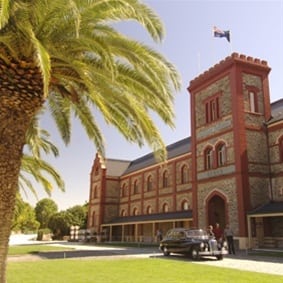
Established in 1890, Château Tanunda lays claim to being Australia’s largest and oldest Château. Vineyards and the Barossa’s first winery were established there in the 1840s. As the winery’s rafters attest, a good many acclaimed winemakers honed their craft here.
However, by the 1990s it had been abandoned by Southcorp. Fortunately businessman John Gerber stumbled across it in 1998 and, unable to resist the challenge of restoring it, bought it the next day.
The emphasis has very much been on restoration. Wines are uncrushed, basket pressed and unfiltered with minimal intervention in a nod to tradition and, of course, with the aim of reflecting terroir.
Château Tanunda Old Vine Semillon
When I chaired the Old Vine Masterclass, Tanunda’s General Manager Matthew McCulloch told me that the estate had a tradition for producing old vine Semillon. Apparently during the 1970s and ‘80s, when Kevin Sobels and Stephen John were the winemakers, it was the biggest buyer of Barossa Semillon. Each year more than 3,000 tonnes were made into sparkling base which was sent to Seppelt Great Western in Victoria.
Briefing me about the background to the ‘new’ 2012-2015 Old Vine Semillons (Tanunda also make a 100 Year Old Vines Shiraz and Grenache), McCulloch told me that the project kicked off when Geber heard that local grower/winemaker Wayne Ahrens was considering grubbing up his Centenarian Vine Semillon block. Instead, Tanunda took the fruit to make a traditionally-styled basket-pressed white wine – Château Tanunda 100 Year Old Vines Semillon.
The block was part of an 18ha vineyard Ahrens had bought in 2007 from an old grower called Ken Schlieb. Located in Vine Vale on the sandy flats of the Barossa Valley floor, it was next door to where Ahren’s great-great-grandfather first settled in the Barossa in 1830s. In the tradition of Barossa’s German vine dressers, the vineyard had been planted as a ‘garden,’ mixing up the grape varieties with fruit trees. McCulloch said wooden fruit-drying racks are still used to dry the prunes and plums each year. In 2008 Wayne and his partner Suzi Hilder (who make Smallfry wines), began the conversion to biodynamics.
The maiden 2012 Semillon was fermented in six year old Dargaud & Jaeglé 225L barriques plus one new Nadalié Perle Blanche barrel – a bespoke white grape fermentation barrel (so the 2012 comprised about 11% new oak). Subsequent vintages have been fermented and aged in the same barrels. Maturation time has been anywhere between six and nine months depending on the vintage, with monthly lees stirring.

Marco Cirillo with old vine 1850s Semillon
While the 2013 also came from Ahrens’ vineyard, the 2014 and 2015 come from even older 150 year old vines. McCulloch told me that, having heard about the old vine Semillon project, Marco Cirillo approached Tanunda with a view to taking some of his Ancestor Vine Semillon for the 2013 vintage. Upon reception at the winery it quickly became apparent that the estate had a new source of Semillon. Cirillo’s vineyard is in Light Pass (less than 4km away) and is planted to the Madeira clone of Semillon. According to McCulloch, “the grapes develop thicker, copper pink skins when fully ripe and the larger berries produce more exotic and tropical fruit notes than the traditional citrus fruit characters.” The Semillon grows in six foot deep silt and sand soil compared to the sandier soil of Vine Vale.
Here are my notes on Chateau Tanunda Old Vines Semillon; click here for my note on the Cirillo 1850 Vines Grenache.
Chateau Tanunda 150 Year Old Vines Semillon 2015
Pale straw with delicate waxy quince, mineral and oilskin nuances to the nose which follow through on the palate. Bracing, rapier-like acidity on the attack – a lunge – makes for a briskly paced, positively breath-taking palate. You could be forgiven for missing its substance and detail. Tightly wound yet intense notes of firm, under-ripe white peach, quince, preserved lemons, grapefruit and minerals tattoo the palate stacatto-style, confident in the knowledge that the bigger picture will emerge with time. For now it’s all about the sensation. The finish is long and firm – super-mineral. Assertive in its persistence. I reckon supremely ageworthy. Fabulous potential. Wow. Would love to see how this plays out; on day three its still very tightly focused but showing a bit more flesh – subtly nougat inflected lees, white peach. A terrifically exciting wine to stash away and eke out over a decade or two.
Chateau Tanunda 150 Year Old Vines Semillon 2014

Pale yellow with green glints. More luscious to nose and palate with salted limes, tropical green fruit (mango?) and nectarines close to the skin – a hint of under-ripeness/rub of phenolics – which brings tension and interest to the palate. . But it’s a little creamy/slippery too, with pillowy lees and just a hint of nougat oak. On day two, it becomes quite honeyed on nose and palate, especially the finish. On day three, it shows some marrowfat peas. A fascinating wine, delivering plenty of complexity already. It doesn’t have the sense of indestructibility of the 2015, but it does have the acid backbone to age well into the mid-term, perhaps longer. 11.5%
Chateau Tanunda 100 Year Old Vines Semillon 2013
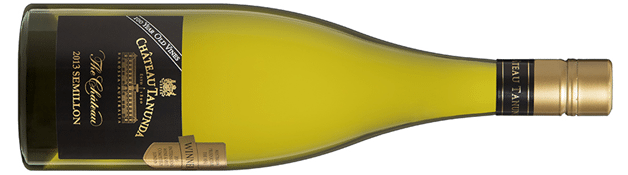
Yellow with a very different complexion to nose and palate – more pungent with oak spice – especially fenugreek, with hints of star anise and clove. It’s more citric too, perhaps a function of bottle age, but I suspect site and clone too. Ditto the relative broadness to its bones, with roasted lemon, skin on and salted lime and lanolin/oilskin nuances. The structure is not as impactful as the 150 Year Old Vines; it doesn’t have the same unerring length and line. But there is something of the rub of phenolics -pithy here. Pungent spices linger, for me detracting a little from this wine. 11.5%
Chateau Tanunda 100 Year Old Vines Semillon 2012
Yellow with gold glints, pungent spice (toasted coriander, fenugreek) and flinty sulphides to nose and palate. It has more pronounced oilskin and lanolin notes to its preserved lemon and orange peel inflected palate than the 2013. Better structure too – it’s firmer and longer with a granular, sandy minerality to the long, flinty struck match, toast and spicy orange peel finish. Still very well focused on day three and, unlike the 2013, the pungency doesn’t get the better of it. The fruit holds its own. Very impressive. 11.5%


Recent Comments
Hi Sarah, Thanks for this great post! Reading your reviews makes me happy that I have a few bottles of (the regular) Noval from 2015 onwards!! All
Thanks for the suggestion. I know Lance Foyster quite well. However I have just found the Wine Society are now listing an Encruzado for £15.50