
Retro-Friday: Malvasia under the microscope

In a table wine context, Malvasia has been playing its part well this week at Decanter World Wine Awards, bringing texture and mid-palate weight to the party, whether flying solo or as a bit part player in a Portuguese blend. Most certainly not what Ricardo Diogo V Freitas was looking for in Barbeito Vó Vera Malvasia 30 Year Old Madeira – the racy, very focused “granny” which was the subject of Monday’s post.
In today’s retro-post (first published almost two years ago to the day) I reported on three close and exquisite encounters with no less than three different types of Malvasia grapes from Portugal: Malvasia de Colares, Malvasia Cândida and Malvasia Branca de São Jorge. Each produced a very different style of wine.
Adega Regional Arenae Colares Malvasia de Colares 2010 (DOC Colares)
Located between the Sintra mountain and the Atlantic ocean just 25km from Lisbon, Colares is the westernmost demarcated region of continental Europe and, with just 12.5ha under vine, the smallest still wine producing region in Portugal. Malvasia de Colares represents around 20% of land under vine on the traditional, phylloxera free sandy soils which define the DOC and which are known as Chão de areia. This bone dry, austere wine enchanted a number of the sommeliers attending the Wines of Portugal Wine Academies which I presented over the last fortnight. Aged in large hardwood toneis or foudres for around eight months it’s a very traditional wine – less about fruit (though it had traces of lemon peel and baked quince) and more about its salty, iodine tang – a signature note which emphasised this wine’s brisk acidity. The first bottle had a fino note which I’ve previously encountered, though a second bottle was cleaner and purer. Both very good in their own, very unique way. 12.5% The 2010 vintage is imported to the UK by Clark Foyster; the 2008 vintage is £19.20 at Nick Dobson Wines.
Blandy’s Malmsey Vintage Madeira 1988 (Madeira)
In Madeira Malvasia also goes under the name of Malmsey. Two strains exist. The original Malvasia Cândida and Malvasia Branca de São Jorge from this wine is made. According to Wine Grapes it was bred from unknown parents by José Leão Ferreira de Almeida at the Esatação Agronómica Nacional near Lisbon and introduced to Madeira in the 1970s. So-called because it is cultivated mainly in the parish of São Jorge on Madeira’s north coast where the Blandy family has long standing relationships with over 26 farmers, total annual production on the island is approximately 120,000 kgs of which Blandy’s buys over 50%. This is Blandy’s first vintage Malmsey release since 2009 (when the 1985 was released). Only 1,589 bottles, bottled in 2013, have been produced and it is well worth seeking out. With knife edge sugar acid balance it is an exceptionally lively, fine, very pure and persistent expression of Malmsey with zesty orange peel, delicate sweetness and tea leaf lift. Delightfully youthful with an appetisingly fresh, clean saline note to its ultra-long finish. 21% abv, Total Acidity: 9.53g/l, Baumé (20ºC): 3.30, Residual Sugar: 123 g/l.
Barbeito Malvasia 20 Year Old Lote 14050 (Madeira)
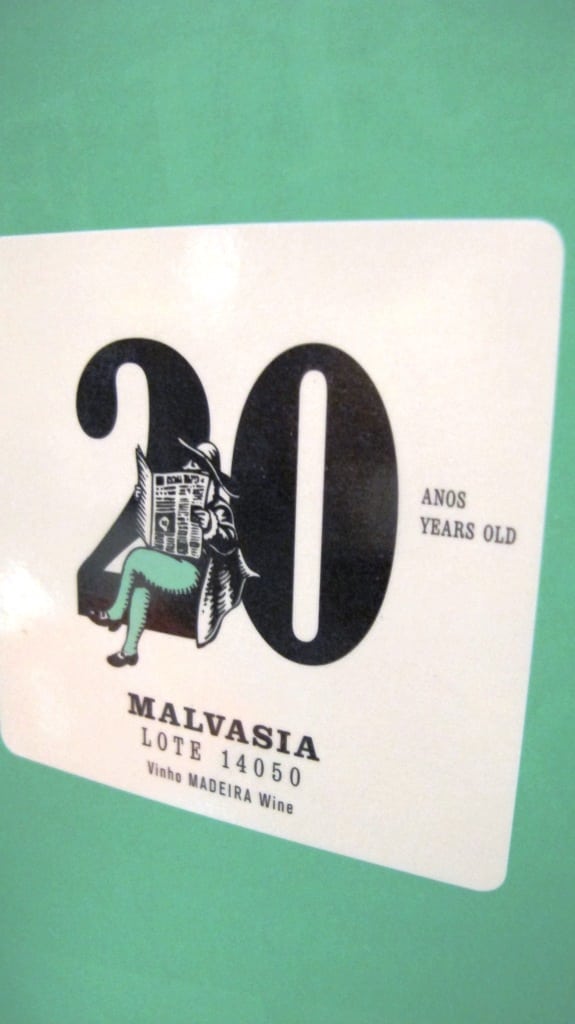
Grapes for this new release were mostly sourced from São Jorge with 20% from Fajã dos Padres. Bottled in February and packaged in a box which as vibrant as the wine (and the same hue as its maker’s grandmother’s Ford Capri!), this Malvasia has plenty of racy verve to its ultra-tightly honed salt caramel and toffeed green apple edged palate. An exhilarating 20 Year Old blend. 20% abv, total acidity 8.04, baume 4.1, residual sugar 98.6g/l. Still, I didn’t miss the opportunity to re-taste the fabulously concentrated Barbeito 40 Year Old Mae Manuela Malvasia Madeira which includes a soupcon of 1860 Madeira.
Barbeito Fajã dos Padres Malvasia Vintage Madeira 1986 (Madeira)
Barbeito’s Ricardo Vasconcelos Freitas has selected the first wines for controlled bottling from the Malvasia Cândida from the titular unique site (Fajã dos Padres) since 1921. The vineyard is located just 50m from the sea down a precipice and was originally planted to Malvasia by Jesuit priests in the second half of the 16th century. It can only be accessed by boat or an elevator. Freitas says since he took responsibility for ageing Fajã dos Padres’ few remaining casks in 2006 this particular wine – just 500l of it remaining – was transferred from a 2000l vat to a smaller format where it remained until 2012 when it was bottled. During this latter part of its development, it was aged in a cooler environment – another tactic aimed at slowing down its development. Deep amber/mahogany in hue it has a concentrated kelpy nose with a rounder, fuller, softer body of dried figs and scorched earth. It is very different from the foregoing racier, zestier and purer examples of Malmsey/Malvasia Branca de São Jorge. Freitas attributes this difference not just to the less than ideal conditions of this wine’s initial ageing but also to the Malvasia Cândida strain. Just 645 bottles produced. A curio with an exciting history which you can read about on Niklas Jorgensen’s site Mad About Madeira. 18,54% abv, Baumé: 4, residual sugar 98g/dm3. I am reliably informed that it is sold by Fortnum & Mason.


Recent Comments
Hi Sarah, Thanks for this great post! Reading your reviews makes me happy that I have a few bottles of (the regular) Noval from 2015 onwards!! All
Thanks for the suggestion. I know Lance Foyster quite well. However I have just found the Wine Society are now listing an Encruzado for £15.50